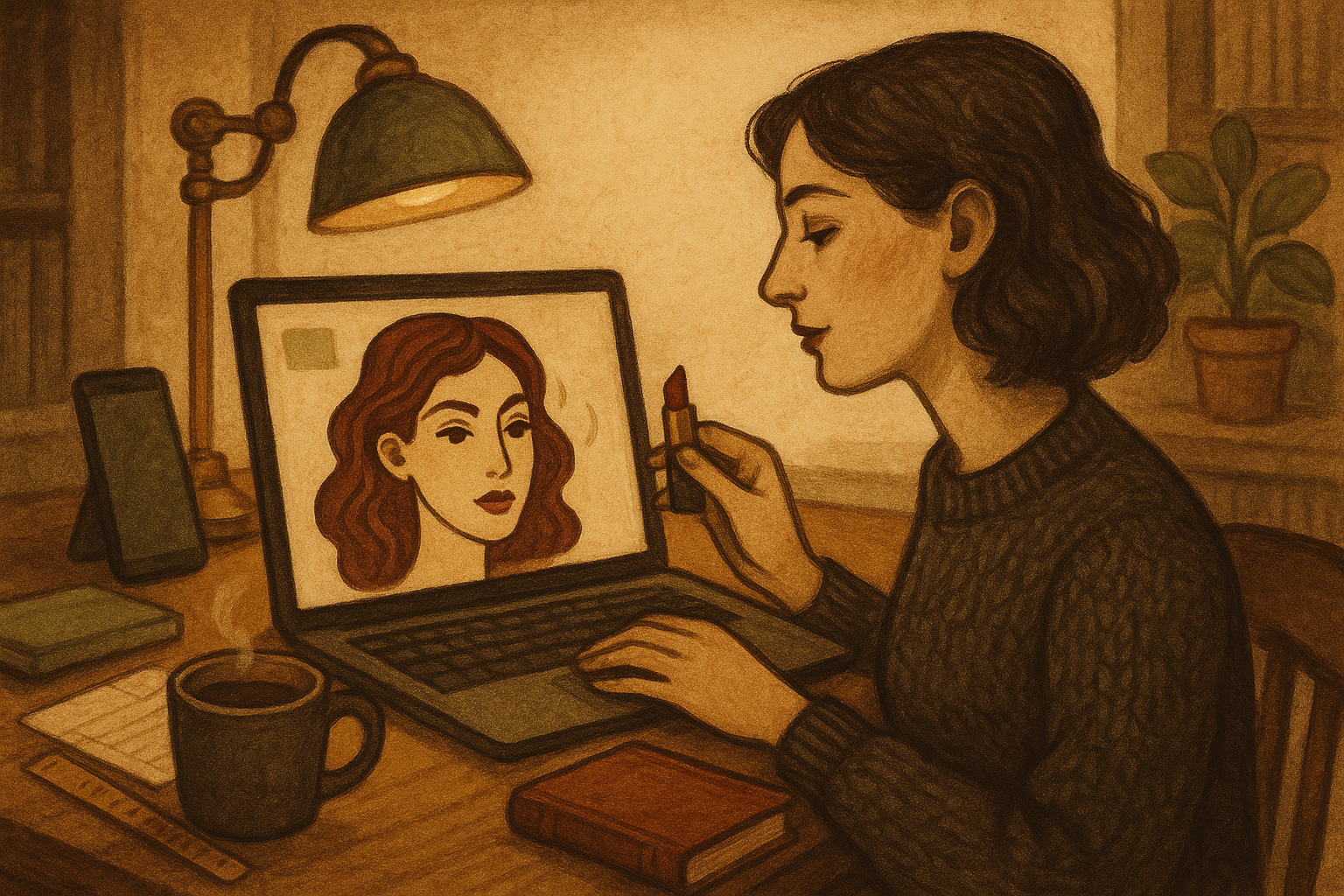
Nobody tells you that doing lashes is basically 90% reading people and 10% technique.
That's not how the school brochure sells it.
After 17 years with a magnifying lamp over my face and someone's eyelid two inches from my hands, I can tell you the real job is paying attention. You notice what a client doesn't say. Whether she's holding tension in her jaw. Whether today she wants to chat or just enjoy an hour of quiet.
You learn to read the person in front of you.
Turns out, that's exactly the skill most people think they're missing when they start using AI.
The Problem Nobody Names Out Loud
If you own a beauty business, you've probably seen the headlines.
AI is changing everything.
You're already behind.
Here's the tool you absolutely have to start using this week.
Then you watch a few YouTube videos, sign up for a free trial, and somewhere around the sentence, "First, connect your API..." you suddenly decide cleaning out the junk drawer sounds like a much better use of your afternoon.
That's not because you're bad at technology.
It's because nobody is translating it into your world.
The people selling AI aren't thinking about appointment reminders, no-show clients, aftercare instructions, inventory orders, or the client who disappears for three years and then texts, "Hey girl!" like she wasn't a missing person.
They're building software.
You're building relationships.
Those are very different jobs.
Why the Courses Didn't Stick
Most AI education starts with the tool instead of the problem.
Click this.
Download that.
Connect this.
It quietly assumes your goal is to become a tech person.
It isn't.
Your goal is to spend less time writing the same follow-up message for the fifteenth time and more time doing the work you actually enjoy.
The other extreme isn't much better.
"Use AI to grow your business."
Great.
Doing what?
For which client?
Between which appointments?
Advice that isn't specific is just noise wearing a headline.
I spent real money learning that lesson. Courses. Subscriptions. Tutorials. The problem was never the software. It was that I was trying to learn AI in the abstract instead of solving one annoying little problem that already existed in my day.
The Reframe: You're Already Doing the Hard Part
Here's what 17 years in a treatment room taught me.
The hardest part of using AI isn't writing prompts.
It's understanding people.
A client sits down and says she wants something "natural."
You immediately start translating.
Her eye shape.
Her lifestyle.
How often she'll come back.
What "natural" has meant the last three times she said it.
That's not instinct.
That's experience.
And it's exactly what AI needs from you.
AI doesn't replace your judgment.
It depends on it.
The better you understand your clients, your business, and your own voice, the better AI performs.
You're not missing technical skills.
You're missing someone to connect the dots.
What This Actually Looks Like
Let's make it practical.
Running a beauty business means you're also the receptionist, customer service department, inventory manager, social media team, and the person answering texts at 9:00 p.m.
That's not a business problem.
That's a mental load problem.
That's where AI shines.
Client follow-up messages.
Aftercare instructions.
Consultation notes.
Website copy.
Service descriptions.
None of those require your best creative thinking every single time. They require context.
You provide the context.
AI gives you a first draft.
You make it sound like you.
Instead of staring at a blinking cursor, you're editing something that already exists.
That shift alone saves an incredible amount of energy.
Does This Actually Work?
It has for me.
A friend asked me to look at her aesthetics website. Nothing was technically wrong with it. It showed up on Google.
It just didn't sound like her.
So I rewrote the copy using something AI will never have on its own: seventeen years in the same industry and a genuine understanding of who she is and who her clients are.
AI helped me write faster.
It didn't replace the thinking.
Her bookings increased, and the five-star review she left never mentioned AI once.
It mentioned that the website finally felt like her.
That's the point.
Technology wasn't the story.
Understanding the human on the other side was.
Where I'd Start
Forget learning AI.
Pick one thing in your business that makes you sigh every time it lands on your to-do list.
Write down exactly how you do it now.
Then open ChatGPT and explain the task the same way you'd explain it to a new employee.
Tell it who it's for.
Show it an example you already like.
Ask it to help.
Edit until it sounds like you.
Repeat next week with one more task.
That's it.
You're not trying to become an AI expert.
You're just making your real workday a little lighter.
I taught myself AI at 56, sitting alone at my kitchen table, convinced I was too old and too late.
Since then I've built apps, websites, and workflows I never imagined I'd be capable of creating.
None of that happened because I'm naturally technical.
It happened because I was stubborn enough to keep solving one small problem at a time.
Turns out that's a pretty good way to learn almost anything.
Keep Learning Without the Noise
If you want to see exactly how I use AI for beauty business tasks, the specific prompts, the real workflows, the stuff that actually saves time instead of just sounding impressive in a headline, that's what I write about every week on Substack. No jargon. No hype. Just what actually worked and what you can steal. Subscribe at simplydoingai.substack.com and the first issue lands in your inbox before your next booking day.
Frequently Asked Questions
Do I need any tech skills to start using AI for my beauty business?
No. The skills you already use every day, reading clients, explaining services in plain terms, knowing what your customers actually need, are more useful than any technical background. The tools themselves are designed to work in plain conversational language, and the hardest part is giving them enough real context, which is something you're already trained to do.
What's the most useful thing AI can actually do for a solo esthetician or lash tech?
The highest-return starting point is usually the writing tasks you do on repeat: client follow-up messages, aftercare instructions, service descriptions, booking page copy. These don't require creativity every time, they require consistent effort, and that's exactly where AI saves the most time without replacing the parts of your work that actually need you.
I've tried ChatGPT before and the results felt generic. What am I doing wrong?
Generic output almost always means generic input. The more real detail you give it, including your tone, your clients, your specific service, even a sample of something you've already written that you liked, the more specific the output gets. Think of it like a consultation: if a client says "I want something natural," you ask follow-up questions. Do the same with the prompt.
Will AI replace estheticians or lash technicians?
No. The skilled, hands-on, relationship-driven work of a beauty professional is exactly the kind of work AI can't replicate. What AI can replace is the administrative drag around that work: the scheduling reminders, the copy, the documentation, the social captions. The goal is to get more of your time back for the work only you can do.
How is using AI for a beauty business different from using it for other small businesses?
The difference is mostly in the inputs. Beauty professionals have unusually deep knowledge of their individual clients and their clients' preferences, which is the exact kind of context that makes AI outputs more useful and more personal. The challenge other industries face, not knowing their audience well enough, is a problem you've already solved.
I don't have a lot of time to learn something new. How long does it realistically take to get a useful result?
A first useful result, something you'd actually send or post, is achievable in about fifteen minutes your first time, and faster after that. The goal is never to become an AI expert. The goal is to solve one specific task faster than you solve it now. Start there, and let the habit build on its own.